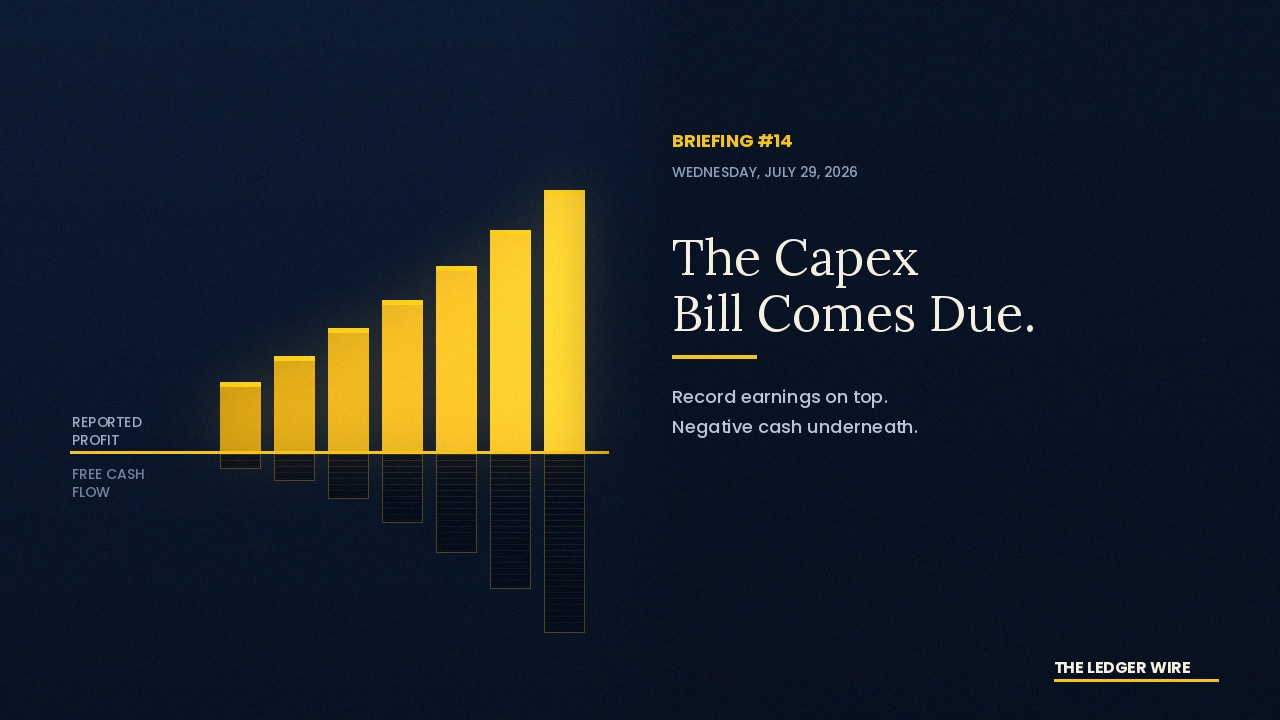
Record profits on the income statement. Negative free cash flow underneath it.
Alphabet posted the biggest earnings beat of the cycle and burned cash doing it. Four of the five largest AI spenders report inside seventy-two hours, the Fed decides on the same afternoon, and the economists who predicted a white-collar bloodbath spent the week walking it back.
Alphabet reported on July 22 and the headline number was absurd: net income up 298%. Then you read the footnote. Roughly $99 billion of that was a paper gain on its stakes in private AI companies. Strip it out and the quarter was an ordinary miss.
Underneath the headline, the real number was negative. Alphabet spent $44.9 billion on capital projects in three months, roughly double a year earlier, and free cash flow came in at minus $5.9 billion. The market understood immediately. AI-exposed equities took the worst of the week’s selling.
Now four of the five biggest spenders report inside seventy-two hours, with the Fed landing in the middle of it. This is the week the theory meets the tape.
Every quarter, a bank tells you it is cutting headcount and getting more efficient. This month one of them said the quiet part into a microphone. Our new documentary walks through the memo, the numbers, and what the language actually concedes.

It pairs directly with section 6 below, where the case against our own thesis got a lot stronger this week. Watch the video, then read that section, and decide which side of it you land on. If it changes how you read a layoff announcement, subscribing to the channel is the best way to support the work.
The reported figures: revenue $119.8 billion, up 24%. Operating income $40.8 billion, up 30%. Net income $112.1 billion, up 298%. Diluted earnings of $9.11 a share.
The asterisk: other income carried a net gain of roughly $99 billion on equity securities, largely marks on private AI and space holdings. That single line added about $6.26 to per-share earnings. Excluding it, the company earned close to $2.85 against consensus near $2.88.
So the biggest earnings headline of the cycle was, operationally, a small miss. And management raised full-year capital spending guidance to $195–205 billion from $180–190 billion, while signalling a further step up next year.
This is the accounting shape worth internalising. A mark-to-market gain on a stake you have not sold is not cash. Capital spending on a data centre is cash, today. One flatters the income statement and the other drains the bank account, and right now they are moving in opposite directions.
Here is the mechanic almost nobody prices correctly. The five largest hyperscalers are tracking north of $725 billion of capital spending in 2026, up from roughly $412 billion last year. But only about $211 billion of that hits 2026 income statements as depreciation. The remainder, more than half a trillion dollars, parks on the balance sheet and gets expensed across future years.
That timing gap is the whole trick. It is how reported earnings can grow more than 20% in a year when cash going out the door is exploding. Nothing improper is happening. It is simply that the bill arrives later than the profit does.
Microsoft reports Wednesday after the close, with consensus near $4.22 a share. It is spending roughly $190 billion in calendar 2026 and the strain is already visible: free cash flow fell to $15.8 billion last quarter on $31.9 billion of capex, down from $25.7 billion two quarters earlier. Azure was guided to 39–40% growth. Hold that line and the spending looks bought. Miss it and the cash math gets uncomfortable fast.
Amazon reports Thursday after the close, consensus near $1.82. Same shape, larger scale. A roughly $200 billion capex plan has pushed trailing free cash flow down to about $1.2 billion, even as operating cash flow rose 30% to $148.5 billion. AWS grew 28% last quarter, its fastest in over three years, on a backlog above $360 billion. That backlog is the entire argument.
Meta and Apple fill out the week. Watch one line in each release and ignore the rest: capital expenditure versus operating cash flow. That ratio is the health of this trade.
The FOMC met Tuesday and Wednesday and announces at 2:00 p.m. Eastern today, with Chair Kevin Warsh taking questions at 2:30. There is no Summary of Economic Projections at this meeting, so no dot plot to parse.
Economists surveyed by FactSet expect rates held at 3.5–3.75%, which would be the fifth consecutive meeting without a move. Futures and prediction markets have leaned the same way, though the hike probability has been live enough to matter, having climbed earlier in the month as oil pushed toward $100 a barrel on Red Sea disruption.
The timing is the story. A rate decision at 2:00 and Microsoft’s capex disclosure after the close, on the same calendar day. Cheap money is the fuel for a debt-financed buildout; the capex line is the size of the fire. You rarely get to observe both inputs inside six hours.
Warsh has signalled he intends to offer less forward guidance than his predecessor. If that holds, the statement language will carry more weight than the press conference, which is a change in how this event should be read.
We owe you the other side of our own video, because it got considerably stronger this week.
Several of the loudest voices predicting an AI-driven white-collar collapse have been publicly moderating. The share of chief executives expecting AI investment to significantly reduce headcount fell from roughly 46% in early 2025 to about 20% by this May. And the labour data has stubbornly refused to break: roughly 139,156 job cuts landed in the first half of 2026 with AI the leading cited reason, yet unemployment held near 4.2%.
Hold that against what companies actually say when they cut. Microsoft eliminated about 4,800 roles on July 9, mostly in gaming, and stated plainly that those roles were not being replaced by AI, while allowing that AI is changing how work gets done. Read that sentence twice. It concedes the technology and denies the causation in the same breath.
So which is it? Our read, and the reason we made the video: both descriptions can be accurate at once. Cuts are real, AI is genuinely reshaping the work, and AI is also the most convenient explanation a management team has been handed in a decade for headcount decisions they wanted to make anyway. A survey of bank executives earlier this year found only 3% reporting AI-driven workforce reductions to date, while a third of large-bank respondents expected headcount reductions within twelve months. The gap between those two numbers is where the argument lives.
Watch the entry level specifically. That is where the evidence is least ambiguous, and where the damage compounds quietly for years before it shows up in a headline unemployment rate.
Semis take the hit: The week’s selling concentrated exactly where the capex anxiety sits. Semiconductor exposure underperformed the broad index by a wide margin, and North Asian AI supply-chain names led the decline.
Oil re-enters the chat: Attacks on Red Sea shipping pushed Brent toward $100 a barrel, layering an energy shock onto an inflation picture the Fed had just about tamed. The AI story does not exist in a vacuum.
Model prices diverge: Frontier model pricing spread out sharply this month, with premium tiers and aggressively cheap tiers pulling apart. If inference costs keep falling at the low end, the revenue case for the expensive end gets harder, not easier.
Cloud growth is not the problem: Azure at 40%, Google Cloud at 82%, AWS at 28%. Demand is not the question anyone is actually asking. Timing is.
Week 7 of 52: Learn to read the cash flow statement before the press release.
This week hands you a perfect training set. Alphabet reported net income of $112 billion and free cash flow of negative $5.9 billion in the same quarter. Both are true. Only one of them tells you whether the business is funding itself.
This week’s action: Open the last quarterly filing of any company you own. Find three lines: operating cash flow, capital expenditure, and net income. Then answer one question. If the capital spending stopped tomorrow, would this company be generating more cash or less? The people who can answer that in ninety seconds are the ones who will not be surprised in eighteen months.
Two weeks ago the story was constraint: a state said no to data centres. This week the story is arithmetic, and arithmetic is harder to argue with. The spending is real, it is accelerating, and for the first time it is showing up as negative free cash flow at a company that prints money for a living.
None of that means the bet is wrong. Amazon burned cash for years and the people who called it a bubble were spectacularly incorrect. The honest position is that we are watching an enormous, deliberate, cash-consuming wager whose payoff arrives on a schedule nobody has been able to specify. Every quarter that the depreciation gap widens, the eventual reckoning gets a little larger and a little more certain in its timing.
And on the jobs question, hold both ideas at once. The apocalypse forecasts were overcooked. The cuts are still happening. Whether AI caused them or merely gave cover for them is the difference between a technology story and a management story, and honestly, it is the more interesting question of the two.
The capex verdict — Microsoft and Amazon numbers land within twenty-four hours of each other. Cloud growth holding plus capex framed as demand is the bull outcome. Anything less keeps the burden of proof on the spenders.
Fed language, not the Fed decision — with less forward guidance on offer, the statement wording is what moves things.
Jobs data — watch entry-level and junior hiring specifically, not the headline rate. That is where this shows up first.
Video 003 in production — where the money in the AI buildout has actually gone, and why the returns are so hard to find.
We’ll be watching all of it.
Join North American professionals who get The Ledger Wire every Wednesday — AI and finance intelligence in 5 minutes flat.
🎉 You're in! Briefing #15 lands next Wednesday.
🔒 Free forever. No spam. Unsubscribe anytime.